
Most advice about what to look for in a personal trainer in Alexandria, VA stops at price, location, and a friendly face, which is roughly how people end up hurt, bored, or no stronger six weeks later.
So what do personal trainers do that actually earns the fee? I’m Victoria Azor, founder of Imperium. Before I started Imperium, I hired more than a dozen trainers, and I either got injured or found the results underwhelming. So I have opinions about where the personal trainer hiring decision goes wrong.
What a Personal Trainer Actually Does, and What to Look For
A real coach does three things before counting a rep: assess your body, build a plan around your goals, and make sure the work is actually measurable. The textbook personal trainer definition never captures the gap between someone who can demonstrate an exercise and a personal fitness trainer who can watch how you move and tell why your shoulder hurts. A private personal trainer working one-on-one closes that gap in a way a crowded floor never will.
If you’re in your 40s, 50s, or 60s, you don’t want to “get fit” in the abstract. You want to build muscle, fix your posture, get out of pain, and stay capable for decades. Most generic personal fitness training never connects the daily workout to those outcomes: no measurement, no real programming, no reason behind the session beyond “it felt hard.”
My philosophy runs the other way. Our goal is to do the least amount of training necessary to produce the greatest possible result. More hours logged is not the mark of a better trainer. It’s often the mark of one who doesn’t know which hour mattered.
Certifications: What the Credentials Really Tell You
Read enough trainer bios and the letters blur together: the NASM certified personal trainer, the ACE certified personal trainer, the ISSA certified personal trainer, the ACSM certified personal trainer, the AFAA certified personal trainer, and the certified strength and conditioning specialist who came up through sports performance. People ask which is the best personal trainer certification program. The honest answer is that no single one guarantees a good coach.
A certification proves someone passed a test. A weekend of personal trainer classes and an online exam is enough to earn one, whether the badge reads NASM personal trainer or something else. It doesn’t prove they can watch you squat and spot the stiff ankle throwing your knee inward. The personal trainer qualifications that change your results are movement and mobility knowledge, real fluency in exercise science, and the judgment to program for one specific body. Those are the skill requirements for a personal trainer that no acronym guarantees.
So don’t choose on alphabet soup alone. Ask a trainer what they can actually assess in your first session, and what they’d do about it.
Personalized Programming Beats a One-Size Session
If I could point you to the single biggest thing to look for, it’s this: a real assessment before a single workout. A mobility and movement assessment tells me where your joints are stiff, where old injuries still shape how you move, and what your posture does under load. Skip it, and every session after is a guess.
A genuine personal training program has three parts you can point to: a baseline measured on day one, a plan built around your body and goals, and progress you can see over months. That’s nothing like the generic personal training services that hand everyone the same circuit, or the small group personal training and off-the-shelf personal trainer packages where the individual disappears into the group’s average.
Our process makes that impossible. Every client starts with a complimentary consultation and trial, where I review your orthopedic and health history and ask two questions: is there something you physically can’t do that you want to, and if you had a magic wand, what one thing about your body would you change? Your first session is built around those answers, not a template, unlike buying personal training packages by the block and hoping a plan shows up later.
Efficiency, Safety, and the Technology Behind Both
Now the myth I most want to kill: that you have to train five days a week to get anywhere. You don’t. People are genuinely surprised how little time it takes to build significant strength and muscle when you train with the right intensity and then let your body recover. You build muscle during recovery, when you’re eating, sleeping, and giving the tissue time to repair.
The other thing to look for is how a trainer protects your joints. Low-impact, high-effort strength training pushes a muscle to its true limit without the pounding and the risky heavy free-weight lifts that grind joints down. You can build strength safely. Most people have just never been shown how.
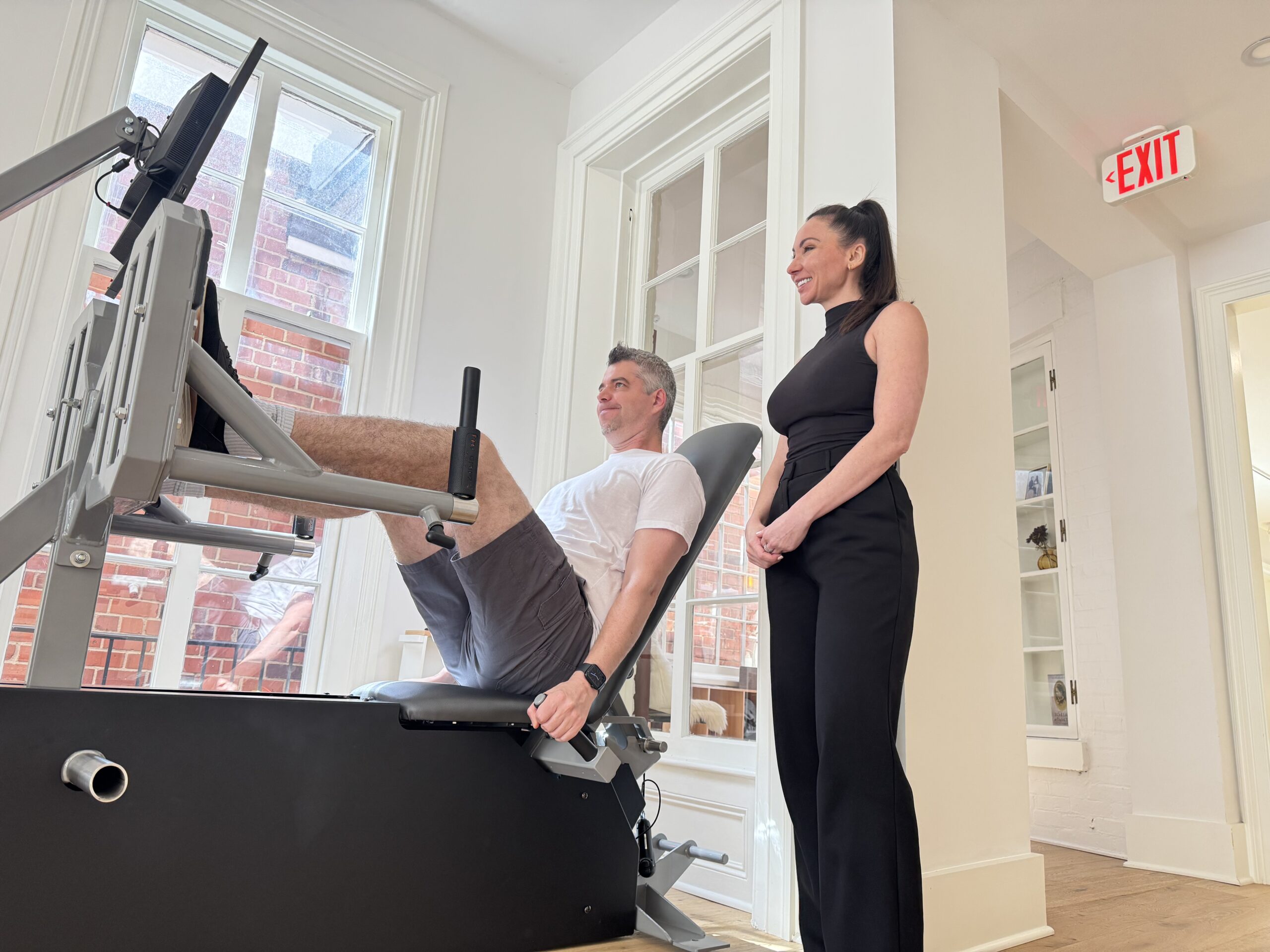
Our technology supports the work rather than defining it. ARX, our Adaptive Resistance Exercise equipment, matches resistance to the exact force you produce through every inch of a movement and records real-time data on what you did, which is why it anchors our personal trainer strength training. The CAROL Bike handles conditioning in a few precise minutes; the Power Plate supports recovery and mobility. Most clients get meaningful results from an efficient 30 minute workout, as little as two sessions a week.
Match the Trainer to Your Goals and Your Life Stage
The right trainer for one goal is the wrong trainer for another. If you want a personal trainer for muscle building, find someone who programs progressive resistance and tracks it, the kind of deliberate personal trainer weight lifting that adds tissue rather than just tiring you out. Personal trainers for weight loss should be talking protein and strength, not just calories burned on a treadmill. A personal trainer for bodybuilding is a specialist in a sport with its own rules. And no trainer can promise a single number on the scale; anyone who does is simply selling something.
Where I plant my flag is longevity fitness training. Strength is what keeps you independent, and it’s the reason personal trainers for seniors and health-conscious adults matter more as bone density starts to slip. I know that firsthand. A DEXA scan in my late thirties showed my bone density approaching the osteoporotic range, and strength training is what turned it around. One of my clients, Pamela Frugoli, started at 74 and has built so much muscle she jokes she needs new clothes because her quads got too big. Good fitness trainers for seniors treat aging as something you train for, not around.
Now the honest part about fit. This training is not for someone who needs to be motivated, monitored, and pushed through every rep. The objection I hear most is “I don’t think I can train on my own.” My answer: a good personal fitness coach builds you toward capable independence on purpose. You’ll understand why you’re doing each exercise and you’ll see the progress, which is what actually sustains motivation.
You’ll also see plenty of remote options while you shop: the remote personal trainer, the online personal trainer, the virtual personal trainer, the newer AI personal trainer app, and the mobile personal trainer. Then there’s the at home personal trainer who comes to you, or the in home personal trainer selling in home personal training. What none of them can do is put hands on your movement, run you on measured equipment, or catch a compensation pattern a camera misses. In-studio coaching includes exactly what those formats leave out.
What You’re Actually Paying For
Personal trainer cost swings wildly because you’re rarely comparing the same thing. Rates shift by market, so a personal trainer NYC quote tells you nothing about training in Alexandria. And the cheap add-ons at gyms with personal trainers, the entry-level blocks a big-box club upsells, usually skip the parts that make training work: the assessment, the individual programming, any real measurement. You’re paying for a room and a rep count.
So be careful judging by rate alone. What looks like affordable personal trainers can cost you far more in wasted months and avoidable injury than a higher hourly rate ever would. Here’s how we start with every client.
| Program | Cost | What it includes |
| Complimentary consultation and ARX trial | Free | Health and injury history review, a goal conversation, and a guided ARX session on exercises chosen for you |
| New Client Program | $500 one-time | Four private sessions to assess your movement and mobility, introduce the technology, establish your baseline, and build your initial program |
After the New Client Program you transition into ongoing membership and train independently on the plan we built, with regular one-on-one check-ins as your strength changes. When you hire a personal trainer here, you’re paying for expert guidance, advanced technology, and progress you can measure, not for hours on a clock.
Questions People Ask Before Choosing a Trainer
How do I find a good personal trainer, and where should I look?
The question of where to find a personal trainer has an easy wrong answer: type “personal trainer Thumbtack” into Google and sort personal trainers in my area by price. That rewards whoever’s cheapest and most available, not whoever’s best. When you’re deciding how to find a good personal trainer, look for a studio that assesses you before it sells you anything, and go in knowing the right questions to ask. That’s the fastest way to find a personal trainer worth your money.
What should certified personal trainers near me actually offer?
If you’re searching for certified personal trainers near me in the Alexandria personal training area, or over in the personal trainer Arlington VA area, hold them to a real standard. Qualified coaching means a movement assessment, a written program built for you, measurable baselines, and a coach who explains the reason behind each session. A rented room and someone counting reps isn’t that, however convenient the location.
How much time does it really take to get results?
Less than you’ve been told. Our model is built on the minimum effective dose: two 30-minute sessions a week, applied with real intensity and backed by proper recovery. You don’t have to organize your life around the gym to get strong. You have to train intelligently, then let your body adapt.
How to get a personal trainer at Planet Fitness?
At a big-box club you typically buy a personal trainer pack at the front desk and get matched with whoever’s on shift, so a Planet Fitness personal trainer rarely knows your history before the first rep. We work the opposite way: you meet me first, we assess your body and goals, and only then do we build a plan, which is why the coaching feels personal rather than assigned.
Is this a good option for a beginner?
Yes, and it’s often better for a beginner than a busy commercial gym. A beginner personal trainer relationship should make starting less intimidating, not more, and a proper assessment plus a personalized plan does exactly that. Because the resistance matches the force you produce, you work hard without loading your joints with weight you’re not ready for.
Book your complimentary consultation
Book your complimentary consultation and ARX trial with us. You’ll meet with me, Victoria, we’ll go through your health and injury history and what you’re actually trying to accomplish, and then you’ll try ARX on exercises chosen for the thing you most want to improve. Reach us through the contact form on our contact page, or call us at 703-909-5888. You’ll walk out knowing exactly what training here would look like for you.

